Introduction
In secure software development, we often assume that the state of a resource (a file, a variable, a permission, etc.) remains unchanged between the moment we check its validity and the moment we use it. This assumption is dangerous. The Time-of-Check to Time-of-Use (TOCTOU) vulnerability occurs precisely within this interval: it’s a race condition where an attacker alters the system’s state between the check and the use, invalidating the security premise.
Scenario 1: The Classic PlayStation 1 Disc Swap
One of the most educational (and nostalgic) examples of a physical TOCTOU occurred in the PS1’s protection mechanism. As I detailed in the post about the history of the console’s anti-piracy, the system relied on reading the wobble groove at the start of the boot process to validate the disc’s region and authenticity.
- Time of Check (t1): The console read the inner track of the CD to validate the “SCEI/SCEA” string in the wobble groove.
- The Window of Opportunity (Δt): After validation, the drive would slow down or momentarily stop to change its rotation speed for data reading.
- Time of Use (t2): The console would begin loading the game data, assuming the disc present was the same one validated seconds earlier.
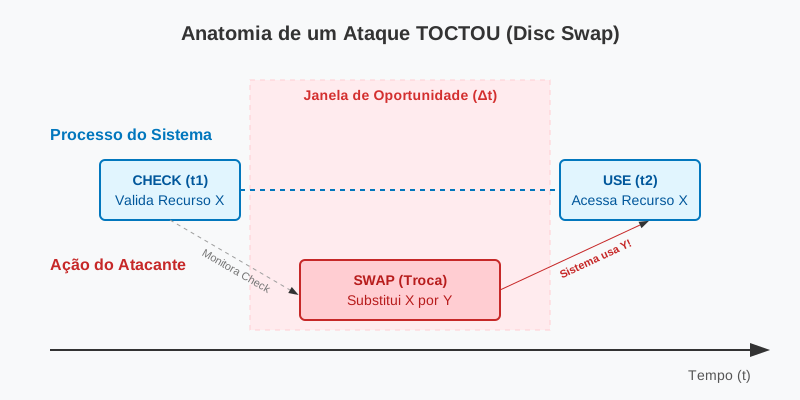
The Disc Swap attack exploited exactly this Δt: the user would remove the original disc (which passed the Check) and insert a pirated one (for the Use). The system, oblivious to this physical state change, would execute unsigned code.
Scenario 2: E-commerce and Discount Coupons (Database)
In web applications, TOCTOU often manifests in business logic, especially with limited promotions. Imagine a store with a coupon code BLACKFRIDAY that only has 100 uses available.
Vulnerable Logic:
- Check:
SELECT remaining_uses FROM coupons WHERE code = 'BLACKFRIDAY' - Logic: If
remaining_uses > 0, allow discount. - Use:
UPDATE coupons SET remaining_uses = remaining_uses - 1
The Attack: An attacker could trigger 50 simultaneous requests (parallel threads) to apply the coupon. It’s highly probable that most threads would read the database in step 1 *before* the first thread manages to execute step 3. The result: the coupon is validated 50 times, but the counter only decrements correctly afterward, causing financial loss.
Solution: Database transactions (SELECT ... FOR UPDATE) or atomic operations (like DECR in Redis).
Scenario 3: Software License Validation (File System)
Consider a modern PC game that uses a local license.key file to validate if the user has purchased the game. The vulnerable pseudocode would be:
// 1. Time of Check
if (!verify_signature("license.key")) {
    die("Invalid license!");
}

// ... small system operations, memory allocation ...

// 2. Time of Use
FILE *f = fopen("license.key", "r");
settings = read_settings(f);
init_game(settings);
The Attack: The attacker creates a script that monitors system calls (syscalls). As soon as the verify_signature function returns success (using a valid license file), the script quickly replaces the license.key file with a malicious one containing settings that unlock DLCs or cheats, before fopen is executed.
The Solution (Loading into Memory): The flaw occurs because the file system is a mutable global state. The fix is to ensure atomicity. Instead of verifying the file on disk and then reopening it, we should load the content into secure memory just once:
// Secure Solution
Buffer *data = load_file_to_memory("license.key");

// Verify the in-memory buffer (which the attacker can't easily alter)
if (!verify_buffer_signature(data)) {
    die("Invalid");
}

// Use the same validated buffer
init_game(data);
Deep Dive: When Memory Isn’t Trustworthy
When we suggest “loading into memory” as a solution, we implicitly assume RAM is an inviolable vault. However, in offensive security, the threat model dictates the rules. If the attacker has hardware access or the kernel is compromised, memory simply becomes another manipulable file, reopening the window for TOCTOU attacks.
To understand the gravity, we need to examine three pillars of the execution environment:
1. The Level of Physical Access
The old security adage says: “If the attacker has physical access to the machine, the machine is no longer yours.” If your software runs on the user’s computer (like a game or a banking client), the user is the “God” of that hardware.
- The Risk: With physical access, an attacker can use techniques like Cold Boot Attacks (freezing RAM to read data after shutdown) or simply use hardware debuggers (JTAG) to pause the CPU precisely in the Δt between check and use, altering values directly in registers or memory.
2. DMA (Direct Memory Access) Attacks
This is perhaps the most elegant way to violate memory integrity without alerting the processor. High-speed interfaces like PCIe, Thunderbolt, and the older FireWire have direct access to system memory (DMA) to ensure performance.
- The TOCTOU Scenario: An attacker can connect a malicious device (like a PCILeech in an M.2 or Thunderbolt slot) that monitors specific memory addresses. The device can read the result of a security check and overwrite the “authorized” bit milliseconds later, all without the CPU even knowing the memory was altered, as the traffic occurs “outside” the normal execution flow.
3. Anti-Tampering and the Illusion of Protection
Many applications rely on software protections (obfuscators, anti-debuggers) or chassis sensors (chassis intrusion) to ensure integrity.
- What they protect: These measures are effective against casual observers and simple automated scripts. They protect the binary on disk from static modification.
- What they DON’T protect: They rarely prevent a well-executed real-time memory attack. If the attacker manages to bypass initial detection, the program’s volatile state (variables on the Heap/Stack) remains exposed to Race Conditions.
4. The Drastic Solution: Hardware Isolation (Enclaves)
Recognizing that main system memory (DRAM) is a “hostile territory” susceptible to manipulation via the kernel or DMA, the industry has adopted a strategy of total isolation. The idea is not just to synchronize memory access but to remove access entirely.
- Widevine L1 (DRM): Used by streaming services to ensure copyright. At L1, video processing and encryption occur within a Trusted Execution Environment (TEE), physically or logically separate from the Android/Linux operating system.
- The Effect: Even if an attacker has root access and full control of main RAM, they cannot access decrypted video buffers or license keys, as these never leave the processor’s secure environment.
- Apple Secure Enclave (SEP): This is a dedicated coprocessor found in Apple devices, with its own secure boot and software. It manages encryption keys and biometric data (FaceID/TouchID).
- The Effect: The main processor (Application Processor) only sends requests to the SEP and receives responses (Yes/No or signed data). Since the SEP’s memory is isolated and encrypted, it becomes impossible for malware or a malicious user on iOS to manipulate the internal state of keys, eliminating attack vectors based on shared memory manipulation.
Conclusion and Lessons Learned
TOCTOU vulnerabilities teach us a fundamental lesson about security engineering: a system’s state is not static. The assumption that “if I checked it, it’s safe” is the central fallacy that enables everything from manually swapping a CD on a PlayStation 1 to sophisticated memory manipulation attacks via DMA on modern servers.
However, the response to this threat isn’t a silver bullet. The complexity of defense must be proportional to the risk of the scenario:
- Web Applications and Routine Scripts: In most cases, the adversary is remote or logical. Here, the solution is to ensure software atomicity. Using database transactions (
FOR UPDATE), file descriptors, and mutexes is sufficient to prevent concurrent threads from exploiting the vulnerability. - High-Security Environments and Physical Access: When the threat model includes an attacker with hardware access—capable of performing DMA attacks or physically manipulating RAM—software protections cease to be sufficient. It is only in these extreme scenarios that hardware isolation technologies become mandatory to remove sensitive state from the attacker’s reach.
Ultimately, fixing TOCTOU is an exercise in threat modeling. It’s up to the developer to ask: “Who can act within this time interval?” If it’s just another thread, a lock will do. If it’s the machine’s owner with a malicious PCIe device, the battle shifts to a different level. Security isn’t about applying every possible defense, but about applying the right defenses for your adversary.
